
CASE STUDY
All case studiesFrom Scattered Payroll Data to Review-Ready Records
How an AI-assisted payroll preparation workflow brought together timesheets, absences, variable compensation and expenses—reducing monthly preparation from approximately two days to just a few hours of review.
01THE CHALLENGE
Payroll preparation started long before anyone processed a payslip.
The business relied on several sources of information to prepare its payroll. Working hours and overtime came from time-tracking records, sick leave and vacation came from employee-management information, variable payments and commissions were maintained separately, and expense reimbursements required reviewing receipts and supporting documents.
Before the payroll team could begin its work, these records needed to be collected, reconciled and organized. Each system contained only part of the information required, so someone had to retrieve the records, match them to the correct employees and combine them into a usable format.
A missing timesheet, an unusual overtime entry, a duplicated expense or a mismatch between attendance and leave information could delay preparation. Staff had to identify discrepancies, investigate the source and request corrections before the payroll package could be finalized.
Payroll information also had to be ready before the processing deadline. When gathering and checking records took too long, the time available for meaningful review became limited, creating operational pressure during a process where accuracy is especially important.
The problem wasn't necessarily the payroll software itself. It was the fragmented preparation process feeding information into it.
02WHAT WE BUILT
One connected workflow for collecting, checking and preparing payroll information.
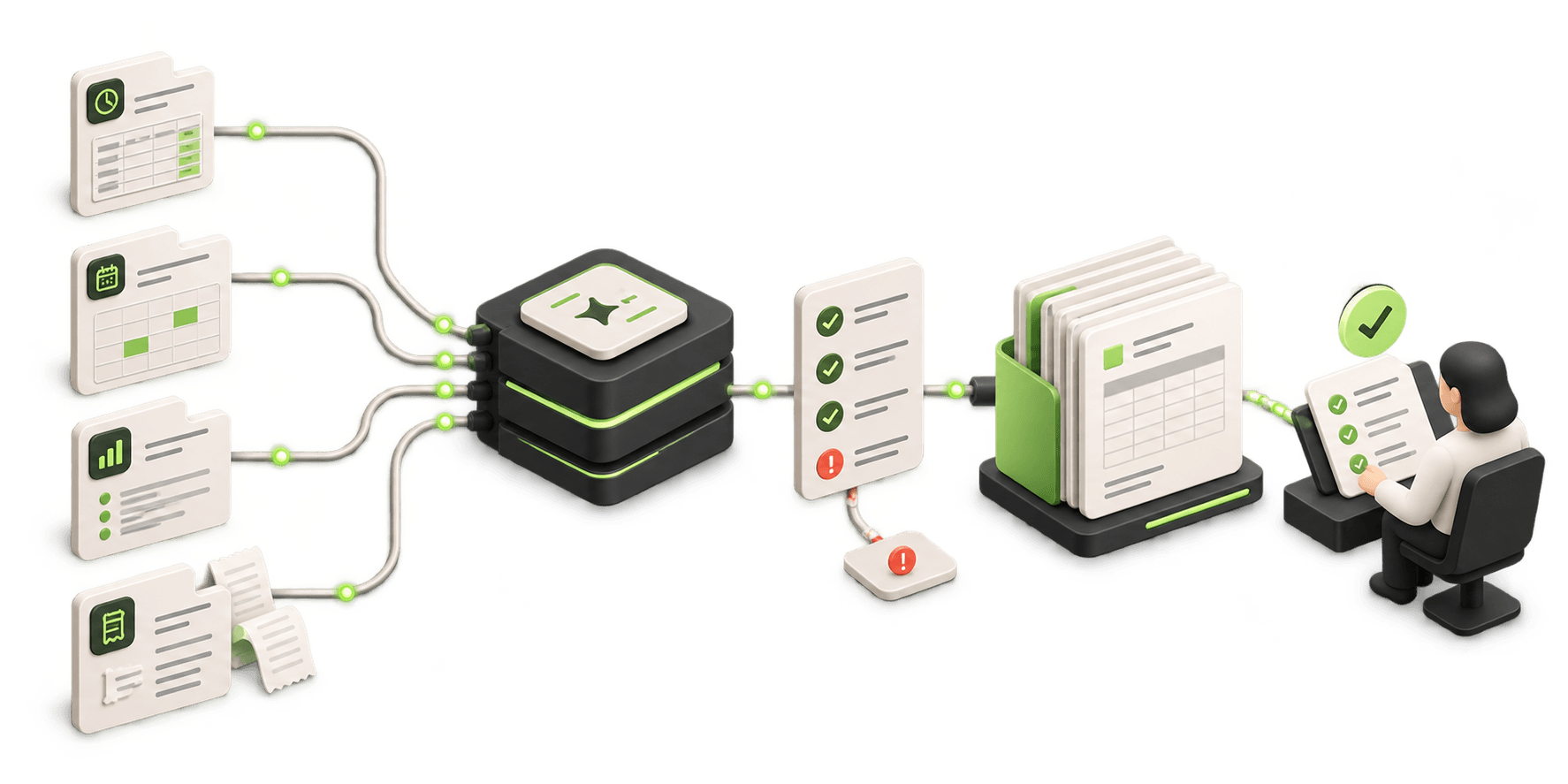
We implemented an AI-assisted preparation system that consolidates relevant employee information from multiple sources before it reaches the payroll processing team. The solution combines system integration, document extraction, structured data handling and automated discrepancy checks.
The workflow gathers relevant records from the business's existing time-tracking, personnel, absence-management, compensation and expense processes. Available information moves into a centralized preparation workflow instead of requiring someone to manually collect every file or transfer each value.
Expense information can arrive through scanned receipts, photographs or PDF documents. Document-reading technology extracts relevant information, including amounts, dates and expense details where those fields can be identified, and organizes the extracted information for further checking.
The workflow brings together records belonging to the same employee and payroll period, including regular working hours, overtime, sick and vacation days, variable compensation, commissions and allowances, reimbursable expenses and other applicable payroll inputs.
Predefined rules and plausibility checks identify information that may require attention, including missing working hours, potentially duplicated expense records, unusual overtime entries, expense documents without required information, conflicts between attendance and leave records and unexpected changes in variable payments. Flagged information is directed to the appropriate reviewer rather than being silently accepted.
Once the available records have been consolidated and reviewed, the workflow prepares information in the structure required by the downstream payroll process. The payroll team receives a more organized package with relevant values and outstanding issues identified.
Payroll calculation, final approval and statutory responsibilities remain with authorized payroll professionals.
03HOW IT WORKS
From disconnected employee records to a consolidated payroll preparation package.
The automation collects payroll inputs, standardizes information, checks for exceptions and prepares records for professional review. Human payroll professionals retain responsibility for final processing and approval.
- 01
Collect Payroll Inputs
The system gathers relevant information from time tracking, absence management, compensation records, expense documents and other configured sources.
- 02
Extract & Standardize Data
AI-assisted document processing extracts available information from supported receipts and documents while other records are mapped into a consistent structure.
- 03
Consolidate by Employee
The workflow organizes working hours, absences, variable payments and reimbursable expenses by employee and payroll period.
- 04
Validate & Flag Exceptions
Predefined checks identify missing information, duplicates, unusual values and potentially inconsistent records. Items requiring judgment or correction are flagged for human review.
- 05
Prepare for Payroll Processing
Consolidated records are organized into the required handover format so authorized personnel can review outstanding exceptions before entering the payroll processing stage.
04THE IMPACT
From two days of payroll preparation to a few hours of review.
The implementation substantially reduced the time required to prepare the information needed for each monthly payroll cycle.
Confirmed reduction in preparation time
Monthly payroll preparation changed from approximately two days of manual work to a few hours of review using consolidated, pre-checked records.
Payroll information consolidated automatically
Employee-related records from different sources are brought into a consistent preparation workflow instead of requiring manual collection and re-entry.
Less repetitive document handling
Expense receipts and supporting documents can be processed through document extraction rather than requiring every relevant field to be typed manually.
Discrepancies identified earlier
Missing values, potential duplicates and unusual records can be flagged before they reach the final payroll processing stage, giving responsible staff an opportunity to investigate and correct issues.
A clearer review process
Reviewers can work from consolidated employee records and a defined list of exceptions instead of spending the preparation period gathering scattered information.
More structured handover to payroll professionals
The payroll team receives prepared information rather than a collection of disconnected records that still require substantial organization.
- Monthly payroll preparation time
- ≈2 days → a few hours
- Verified. Confirmed implementation outcome
05KEY TAKEAWAYS
Reliable payroll begins with reliable information.
- 01
Automate the preparation before replacing the process
The largest repetitive workload may exist before the final payroll calculation begins. Collecting, organizing and checking inputs can be automated while retaining the existing payroll system and professional approval process.
- 02
Data quality matters more than moving data quickly
Connecting systems is only one part of the implementation. The workflow also needs to identify missing information, conflicting records and unusual values before those issues affect downstream operations.
- 03
Exceptions need a clear human owner
Not every discrepancy can or should be resolved automatically. A dependable process makes unusual cases visible and routes them to someone authorized to investigate.
- 04
Sensitive operations need clear boundaries
Payroll information is highly sensitive. Access permissions, secure processing, appropriate retention practices and traceability are important considerations, while AI should support payroll professionals without taking over responsibilities that require human approval.
06NEXT STEP
How much time does your team spend preparing information before payroll can even begin?
If your payroll process depends on collecting timesheets, reconciling expenses, checking absences and transferring variable compensation between systems, repetitive administration may be consuming more time than necessary. We help businesses identify these operational bottlenecks and implement AI-assisted workflows around the systems they already use. From document extraction and data consolidation to validation and structured handover, the goal is to reduce repetitive preparation while keeping control with the people responsible for the final outcome.