CASE STUDY / TECHNOLOGY & SOFTWARE
All case studiesFrom Scattered Customer Updates to Source-Backed Answers
How a B2B technology company connected customer information across six operational sources, created a live change radar, and built human approval into AI-assisted actions.
01THE CHALLENGE
Customer information was available everywhere, but the full picture existed nowhere.
A customer project can look completely different depending on which system someone opens. The CRM shows the commercial status. The ticket board shows delivery work. Internal messages explain why something changed. Documentation captures part of the history. And a meeting may have introduced a decision that hasn't reached any of those records.
For one B2B technology company, understanding the latest customer status meant piecing together information across departments and tools—and sometimes asking colleagues what had actually been agreed.
We implemented an operational context layer that connects customer-related information across six source categories and brings relevant changes into one view.
The system organizes updates by customer, identifies where information came from, and provides source-backed answers within the requesting employee's access permissions. When an AI assistant proposes an external action, the responsible person must approve it before the change is made.
The customer change radar is operating in production. An additional capability for sharing approved meeting decisions with the relevant teams is being implemented as part of the ongoing project.
The company managed complex B2B customer relationships involving sales, engineering, delivery, operations and management. Each team worked in systems suited to its responsibilities. Those systems contained useful information, but they didn't automatically explain how individual updates related to the current state of a customer project.
Every department had a different version of the customer status. Sales might see a deal progressing through the CRM while engineering was still working through unresolved delivery requirements. A ticket could show that work had started, while a message in another system explained that the customer had changed the expected timeline. An employee trying to understand the current situation needed to connect those separate records manually. No individual system offered a complete view of what had changed across the customer relationship.
Important decisions were difficult to trace. Some of the most consequential information originated in meetings, calls or discussions. A delivery date might have been revised. A scope limitation could have been agreed. A colleague might have confirmed a dependency that affected several teams. But the resulting decision wasn't always reflected immediately in the ticket board, documentation or CRM. Employees who weren't part of the conversation could miss information relevant to their work.
Existing summaries lacked the context needed for confident decisions. Individual tools already provided summaries of messages, pages and tasks. But summarizing one source wasn't enough to explain the relationship between changes across several systems. Employees still needed to know who made a statement, when it was made, which source supported it and whether more recent information had superseded it. Without that evidence, a plausible AI-generated answer could create another question: could the employee trust it without checking the original record?
Giving AI access to more systems introduced new operational risks. A connected assistant could potentially retrieve information from several departments and propose changes across multiple tools. That made permission boundaries and approval responsibilities essential. An employee shouldn't receive information they aren't authorized to access merely because an AI system can connect to the source. Similarly, an assistant shouldn't update a customer record, post a comment or create a task without the appropriate person authorizing the action. The business needed connected context and controlled actions—not an unrestricted assistant with broad access to operational systems.
02WHAT WE BUILT
A permission-aware customer context layer connecting information, evidence and controlled actions.
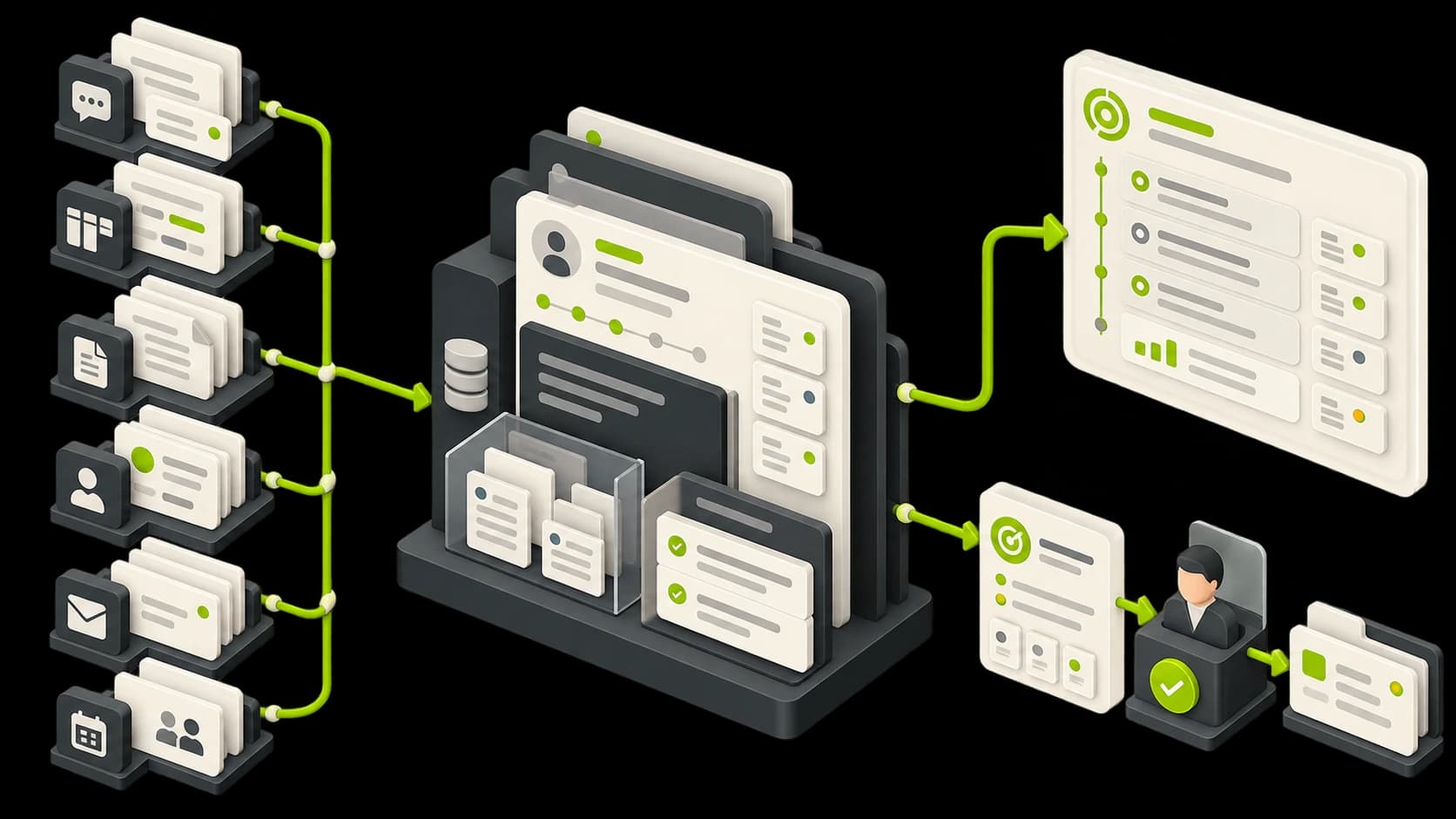
We implemented an operational context system that sits across the company's existing collaboration, customer-management and work-tracking tools. The solution combines customer-level data mapping, source-linked information retrieval, a production change radar and a human-controlled action workflow.
Unified customer context across six source categories: We connected information from internal chat, ticketing, documentation, CRM, mailboxes and meeting-related records. The system associates relevant updates with the customer or project they concern. Instead of treating a ticket, a deal and a conversation as unrelated records, it helps employees see those changes together. A live change radar organizes the activity by customer and highlights updates relevant to the employee reviewing them. This gives users a practical starting point for understanding what has happened since their previous check.
Source-linked and time-aware information: We implemented a structured context model that associates information with its source, relevant customer, recorded time and supporting evidence. This helps distinguish a current customer status from an older statement that may no longer apply. Where appropriate, information can be represented as relationships within a time-aware knowledge graph. Facts entered into that shared context require human confirmation or an authorized sharing decision; merely reading source content does not automatically make it an approved organizational fact. The underlying design preserves the distinction between finding information and establishing a fact the organization can reuse.
Permission-aware answers and retrieval: The system evaluates information within the access rights of the person making the request. A user can ask about a customer, a change or an operational decision and receive an answer supported by relevant source references. The response is limited to the information that user is permitted to access. Where the system cannot establish an answer from accessible evidence, it can report that the information wasn't found rather than inventing a conclusion. This makes source-backed retrieval useful without treating a connected AI assistant as an unrestricted company-wide search account.
A human-controlled proposal and approval workflow: We implemented an action inbox for proposed facts and operational changes. An assistant can suggest an action, such as commenting on an existing ticket, adding information to a relevant record or preparing a message in the corresponding discussion. The proposal is presented with its source and supporting context. The responsible employee can review, revise, approve or reject the proposal. External updates remain subject to that approval boundary, including actions initiated through connected assistant interfaces. The system also records the decision and related action evidence so that the approval history remains reviewable.
Connected briefings and assistant access: The context layer supports a customer change radar, short operational briefings and source-backed questions. Multiple supported interfaces use the same controlled backend rather than creating independent stores of customer knowledge. The implementation also includes work on a more structured handover process for decisions captured in meetings. Under that extension, a confirmed decision can be associated with its original context and shared with the appropriate team under defined permissions and consent. The automatic cross-team meeting-handover capability is still being implemented and should not be treated as a completed production rollout.
03HOW IT WORKS
From an operational change to a sourced answer—or a person-approved action.
The system has two related but distinct purposes: helping employees understand what changed and allowing controlled updates when an action is needed. Reading information does not automatically authorize a write.
- 01
Read relevant updates from connected systems
The context layer receives a user's question or checks the operational sources for relevant changes. It retrieves information from supported chat, ticketing, documentation, CRM, mailbox and meeting-related sources using the available permissions associated with the request. The system does not assume that the user can access everything connected to the platform.
- 02
Connect the information to the relevant customer
The retrieved changes are associated with the relevant customer or project. The system preserves source information, including where the update originated and the time associated with it. This helps bring related ticket updates, customer messages and commercial developments into one operational context. Where a source cannot be read, the system can distinguish unavailable information from a genuine absence of changes.
- 03
Present the change radar or a source-backed answer
The employee can review a customer-focused view of recent activity or ask a question about the available information. The system presents relevant changes with supporting source references. Where appropriate, a short briefing summarizes what has changed since the employee's previous review. The user can follow the evidence back to the underlying record rather than relying only on a generated summary. For read-only questions, the workflow can end here without changing any operational system.
- 04
Create a proposal when a decision or action is needed
If a customer update suggests that an operational record should be changed, the assistant can prepare a proposal. The proposal identifies the suggested action and includes its supporting context. A separate proposal can be created for a fact that someone needs to confirm before it becomes part of the organization's shared context. These proposals remain pending until the responsible person reviews them. The assistant does not approve its own actions.
- 05
Record the decision and execute only authorized changes
The employee can approve, modify or reject the proposed action. An approved external action can then be applied through the corresponding connected system under the established authorization process. The decision and related evidence remain associated with the action. Separately, confirmed facts can be recorded with their origin and relevant time context. The extension for automatically delivering those approved meeting-derived facts to the appropriate teams is being implemented as part of the ongoing project. This separates the live source-reading and approval workflow from the additional cross-team knowledge-sharing rollout.
04THE IMPACT
Teams gained a connected view of customer activity without giving AI unrestricted authority.
The implemented production system brings customer updates from multiple operational sources into a shared context and supports reviewable, human-controlled actions. The outcomes below describe established capabilities. Exact time savings, financial returns and infrastructure performance improvements have not been independently confirmed for publication.
A live view brings changes together across systems
The production customer radar consolidates relevant activity from six source categories. Employees can review customer-related changes in one place rather than reconstructing the situation independently from every connected tool.
Answers can be traced back to their source
Relevant updates and generated answers retain references to the underlying information. This gives employees a way to understand where a statement came from and investigate the original record when necessary.
Information access follows the requesting employee
The context layer is designed around the permissions of the person asking the question. This helps prevent connected sources from being treated as an unrestricted pool of company information.
AI-assisted actions remain subject to human decisions
The assistant can prepare proposed updates without independently authorizing them. The action inbox gives the responsible employee a clear place to examine the proposal and its evidence before a change is made.
A foundation for better cross-team decision handovers
The time-aware context model provides a way to associate important statements with their origin, confirmation and relevant customer. The ongoing meeting-handover extension is intended to make approved decisions available to colleagues who need them but weren't present when those decisions were made. That extension remains under implementation and is not claimed as a completed production-wide outcome. The central business value is a more dependable connection between what changed, where the evidence lives and who is authorized to act.
05KEY TAKEAWAYS
Connected context makes customer information easier to understand and safer to act on.
- 01
Connecting systems is not enough; information needs a shared operational context.
A CRM deal, ticket update and internal discussion may all describe the same customer situation. A useful context layer connects those records so teams can understand the relationship between them.
- 02
AI-generated answers should preserve their evidence.
Employees need to know where information originated and whether it is still relevant. Source references and time context make an operational answer easier to review than an unsupported summary.
- 03
Permission boundaries and action approval solve different problems.
Reading a record requires appropriate access. Changing that record requires the right person to authorize the action. An effective system needs to enforce both boundaries.
- 04
Shared organizational knowledge should distinguish observed information from confirmed decisions.
Finding a statement in a meeting or message does not automatically make it an approved organizational fact. Human confirmation, source history and scoped sharing help build reusable context without treating every retrieved statement as authoritative.
06NEXT STEP
Are your teams still searching across multiple tools to understand one customer?
If important customer decisions are scattered across collaboration tools, CRM records, tickets and meetings, your teams may be spending more time reconstructing context than acting on it.
At 99xAutomation, we design and implement connected AI and operational systems that bring information together, preserve source context and keep important actions under human control.