CASE STUDY
All case studiesFrom Unanswered Sales Messages to Qualified, Booked Appointments
How an AI-powered messaging agent helps a sales team respond to incoming enquiries around the clock, answer common questions, qualify prospects and book appointments—with human handover when needed.
01THE CHALLENGE
A potential customer was ready to talk. Nobody was available to respond.
Incoming sales enquiries don't always arrive when a team member is sitting at a desk. Prospects may message during lunch breaks, evenings or weekends with a straightforward question about a service, pricing information or an appointment.
But in a busy sales operation, messages compete with phone calls, existing customers, proposals and other daily responsibilities. When the team was occupied or unavailable, prospects had to wait, creating a gap between initial interest and the business's response.
A large proportion of initial conversations involved familiar topics such as services, availability, pricing ranges, booking procedures and general conditions. Sales staff repeatedly typed similar responses even when the necessary information was already available in the business's internal resources.
Before a meaningful sales conversation, the team often needed basic information about the prospect's requirements, timeframe, budget or location. Collecting those details and coordinating appointment availability created additional back-and-forth, while complex enquiries needed a reliable way to reach the right person.
The business didn't simply need faster notifications. It needed a dependable first-response system that could recognize when to automate and when to involve a human.
02WHAT WE BUILT
An AI sales agent that handles initial conversations and knows when to hand over.
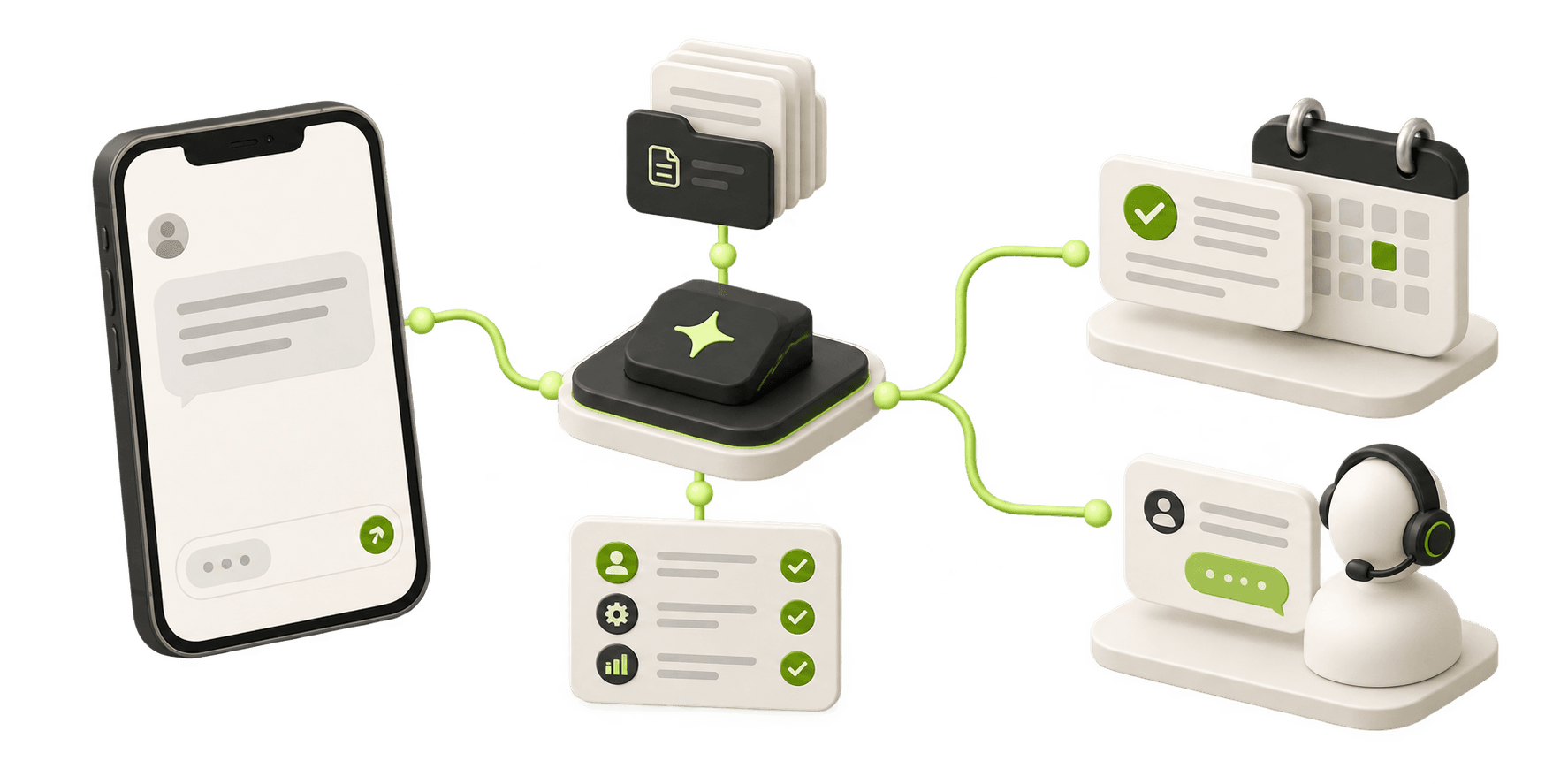
We implemented a conversational AI workflow connected to the business's messaging channel, approved company knowledge, lead-management information and appointment scheduling process.
Instead of using only rigid predefined chatbot buttons, the system interprets incoming messages and determines the appropriate next step. It can respond to routine initial enquiries during busy periods and outside normal working hours without waiting for a salesperson to become available.
The agent uses approved information about the business's services, availability, general conditions and frequently asked questions. Relevant information is retrieved from the configured business knowledge source, responses follow defined communication guidelines and questions that cannot be answered reliably are directed to a human rather than handled through unsupported assumptions.
When a prospect expresses interest in a service or appointment, the agent asks appropriate follow-up questions about the service or solution required, specific needs, budget or expected investment, desired timeframe and relevant location or service area. The process remains conversational rather than forcing every prospect through the same rigid questionnaire.
When an enquiry is suitable for booking, the agent connects with the appointment scheduling system to check available time slots, suggest relevant availability, confirm a selected appointment and provide the prospect with booking information.
Not every sales enquiry should be handled entirely by AI. Requests for a human representative, sensitive or unusual questions, individual negotiations, important enquiries requiring special handling and requests outside the agent's available knowledge or authority can trigger escalation. The conversation and relevant collected information are made available to the human representative, and the automated agent stops responding during the human takeover.
The goal is to automate the repetitive beginning of the sales conversation while preserving human judgment when it matters.
03HOW IT WORKS
From incoming message to qualified enquiry, booking or human handover.
The workflow connects initial enquiries, AI responses, qualification and conditional scheduling or human escalation. Booking and human escalation are alternative outcomes, not sequential steps in every conversation.
- 01
Receive the Enquiry
A potential customer sends a message through the business's supported messaging channel. The automation receives the enquiry and checks available conversation or customer context.
- 02
Understand & Respond
The AI agent interprets the request, identifies the prospect's intent and retrieves relevant information from the approved business knowledge source. Routine questions receive responses aligned with configured communication guidelines.
- 03
Qualify the Prospect
For enquiries that require further information, the agent asks relevant qualifying questions and organizes the responses to help determine the appropriate next action.
- 04
Book an Appointment
Where suitable, the agent checks available appointment slots and helps the prospect schedule a meeting or consultation through the connected scheduling process.
- 05
Escalate When Necessary
If the enquiry requires human judgment, falls outside the agent's scope or the prospect requests a person, the workflow transfers the conversation with its relevant context so a human representative can take over.
04THE IMPACT
A more responsive and structured first point of contact for sales enquiries.
The implementation changes how initial sales conversations are received and handled while preserving human judgment for complex or sensitive situations.
Around-the-clock initial response capability
The AI agent can handle supported incoming enquiries outside ordinary business hours without requiring a team member to monitor every message.
Less repetitive question handling
Common enquiries can be answered using approved business information, reducing the need for sales staff to type the same responses repeatedly.
More structured lead qualification
Prospects can be guided through relevant qualifying questions before the team becomes involved in a sales conversation.
Appointments coordinated through the conversation
Suitable prospects can book available appointments without requiring a salesperson to manually exchange multiple scheduling messages.
Clearer human handover
Complex enquiries can be transferred with the relevant conversation history, reducing the need for prospects to repeat information.
More focused use of sales-team attention
The agent supports routine first-contact activity, allowing people to concentrate on more involved discussions, negotiations and customer relationships.
05KEY TAKEAWAYS
Faster first contact is valuable. Knowing when to involve a person is just as important.
- 01
Sales enquiries don't follow office hours
Potential customers may reach out whenever they have a question or need. An automated first-response process helps businesses handle supported enquiries without depending entirely on staff availability.
- 02
An effective AI agent needs reliable business knowledge
Natural-language understanding alone isn't enough. The agent also needs appropriate, approved information and clear boundaries around what it can answer.
- 03
Qualification should feel like a conversation
Gathering requirements, timeframe and other relevant details shouldn't require a long, rigid form. Conversational workflows can collect useful information while remaining responsive to the prospect's original question.
- 04
Human handover must be built into the design
The most useful agent isn't necessarily the one that attempts to handle everything. It's the one that completes routine work, recognizes its limitations and transfers conversations smoothly when a person is needed.
06NEXT STEP
How many sales enquiries arrive when your team isn't available?
If your business receives enquiries through messaging channels, your team may be spending valuable time answering repetitive questions, qualifying prospects and coordinating appointments. We help businesses implement AI systems that connect customer conversations with the operational tools their teams already use. From conversational AI and lead qualification to appointment booking and human handover, the goal is to build a more responsive sales process without sacrificing personal service.