CASE STUDY
All case studiesTurning Dormant Customer Records Into New Sales Conversations
How an AI-assisted win-back system helps an automotive business reconnect with dormant contacts through customer segmentation, personalized outreach and automated follow-up.
01THE CHALLENGE
The contacts were already there. The follow-up wasn't.
Most businesses spend time and money generating enquiries, building customer records and growing their CRM. Over time, many of those contacts go quiet: some purchased in the past, some enquired but never converted and others engaged for a while before disappearing.
The business had accumulated a database of inactive leads and past customers. The underlying problem was not a lack of customer information, but the absence of a consistent process for deciding which contacts should be approached, what message would be appropriate and when someone from the team needed to intervene.
Inactive contacts were treated as one group even though a previous buyer, an old enquiry and someone who stopped responding after an unsatisfactory experience have different histories. Sending identical messages to every inactive contact ignores those differences.
Manual personalization was difficult to maintain. Creating relevant follow-up messages requires reviewing customer history, understanding previous interactions and adapting the communication. Doing that individually across a large contact database creates substantial repetitive work.
Reactivation also lacked consistent rules. Some contacts may be appropriate for automated outreach, others require human attention and some should not receive further marketing communication. Without clear segmentation, eligibility checks and suppression rules, campaigns become inconsistent and difficult to manage.
The opportunity was not simply to send more emails. It was to create a more intelligent, controlled process for reconnecting with existing contacts.
02WHAT WE BUILT
An AI-assisted reactivation workflow built around customer history.
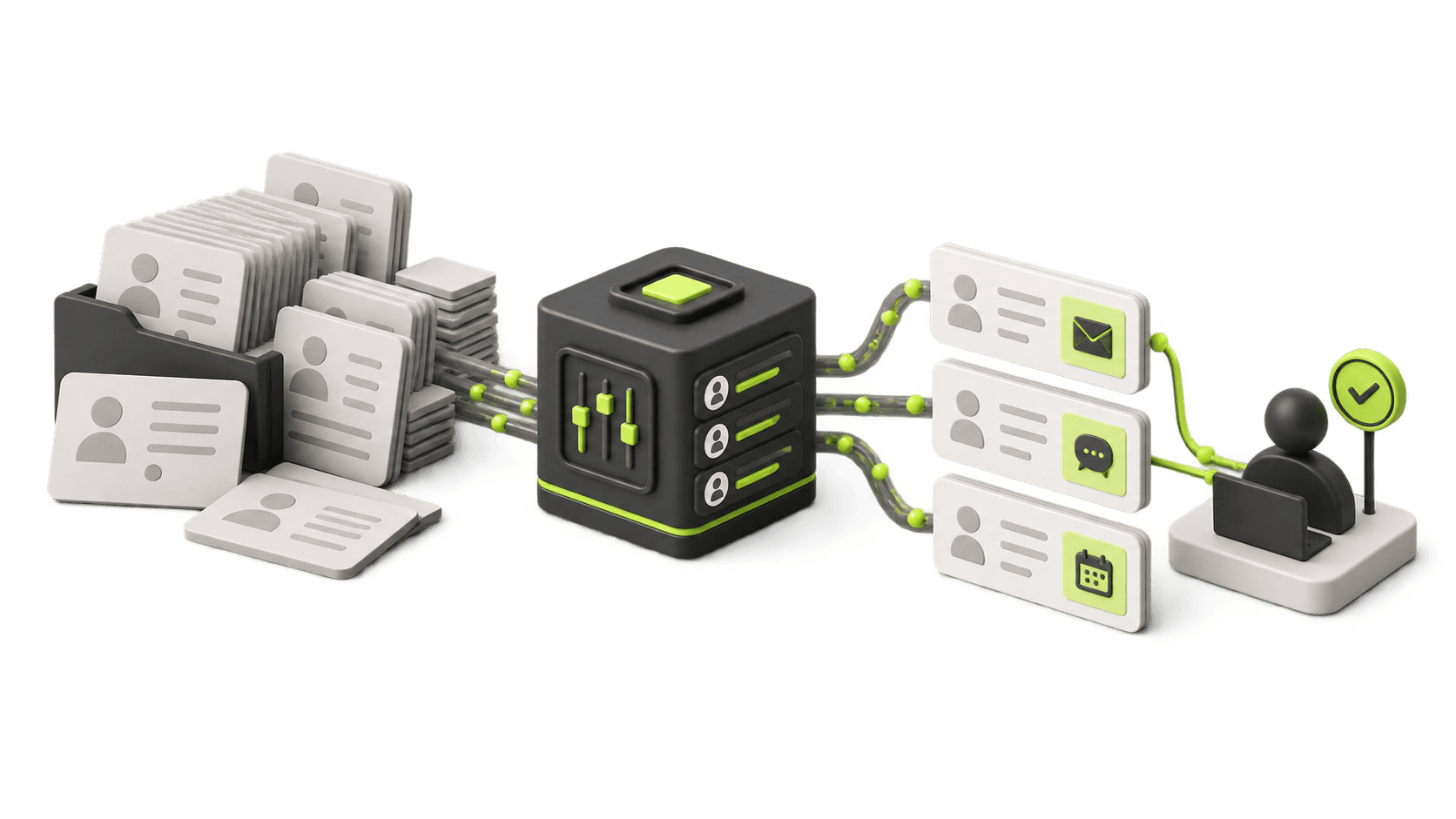
We implemented a workflow that brings together CRM information, segmentation, AI-assisted messaging and campaign automation. The system organizes inactive contacts and supports more relevant re-engagement without requiring the team to prepare every campaign variation manually.
The workflow reviews customer and engagement data to identify records matching defined inactivity conditions, including time since the last interaction, previous purchases, enquiry history and other available CRM activity.
Contacts are grouped according to relevant aspects of their relationship with the business, such as previous customers who have not returned, prospects who enquired but did not convert, repeat-purchase contacts, prolonged inactivity or records requiring additional human review.
AI uses approved messaging instructions, campaign context and available customer information to support segment-specific win-back emails. Brand tone, appropriate offers and communication boundaries guide the content.
The workflow supports planned reactivation sequences rather than isolated mass emails, including initial reconnection, value-based follow-up, a relevant reminder or permitted offer and a final follow-up according to approved campaign rules.
Sensitive records, important accounts and cases requiring additional context can be directed to a human team member. Invalid, unsubscribed or otherwise ineligible addresses are excluded from further sends as appropriate, and unresponsive contacts can be suppressed according to the campaign rules.
The result is a more structured way to manage dormant contacts, combining automation with clear boundaries for human involvement.
03HOW IT WORKS
From inactive CRM records to structured re-engagement.
The system connects customer information, segmentation and personalized communication into a repeatable win-back workflow.
- 01
Identify Dormant Contacts
The workflow reviews CRM records and engagement history to identify contacts meeting defined inactivity criteria.
- 02
Segment by Customer History
Eligible contacts are grouped according to previous purchases, enquiries, inactivity duration and engagement patterns.
- 03
Prepare Personalized Messaging
AI assists with targeted email messages based on customer segments, approved brand guidelines and permitted campaign offers.
- 04
Execute & Monitor Follow-Ups
Eligible contacts enter the appropriate reactivation sequence, with staged messaging and available engagement signals guiding subsequent actions.
- 05
Re-engage, Escalate or Suppress
Responding contacts can be routed to sales or customer-service follow-up, sensitive cases can be escalated and contacts who should not receive outreach can be suppressed.
04THE IMPACT
From a passive customer database to an organized reactivation process.
The implementation provides a structured way to identify and approach dormant contacts using existing customer information.
More organized inactive-contact data
The workflow identifies and groups dormant contacts using consistent inactivity and eligibility criteria instead of leaving records untouched.
More relevant reactivation messaging
Customer segmentation and AI-assisted drafting enable communication to reflect previous interactions rather than relying solely on generic mass emails.
Less repetitive campaign preparation
The workflow reduces the manual effort required to organize eligible contacts, prepare message variations and coordinate follow-up sequences.
Clearer opportunities for sales follow-up
Contacts who respond or require individualized attention can be routed to the appropriate team members.
More controlled contact management
Eligibility checks, escalation rules and suppression handling help maintain a clearer process for deciding who should receive automated communication.
05KEY TAKEAWAYS
Customer reactivation works better when the process understands the contact.
- 01
Customer history matters
A previous buyer and an old enquiry should not automatically receive the same communication. Effective reactivation begins with understanding the nature of the existing relationship.
- 02
Segmentation makes outreach more relevant
Personalization is more than inserting a first name into an email. Customer history, previous activity and defined business rules create a better foundation for targeted messaging.
- 03
Automation needs clear boundaries
Not every inactive contact should receive repeated outreach. Eligibility, opt-out handling, suppression rules and appropriate human escalation are essential parts of responsible campaign design.
- 04
AI should support customer relationships
AI can help organize data, prepare messages and coordinate repetitive follow-up tasks. Complex requests and sensitive issues still require human involvement.
06NEXT STEP
There may already be pipeline sitting inside your CRM.
If your business has inactive leads, past customers or untouched records that never received structured follow-up, there may be opportunities to reconnect. We help businesses build AI-assisted systems that turn scattered customer information into more organized sales and marketing workflows. From CRM segmentation and personalized messaging to automated follow-up and human escalation, the goal is to make existing customer relationships easier to manage.